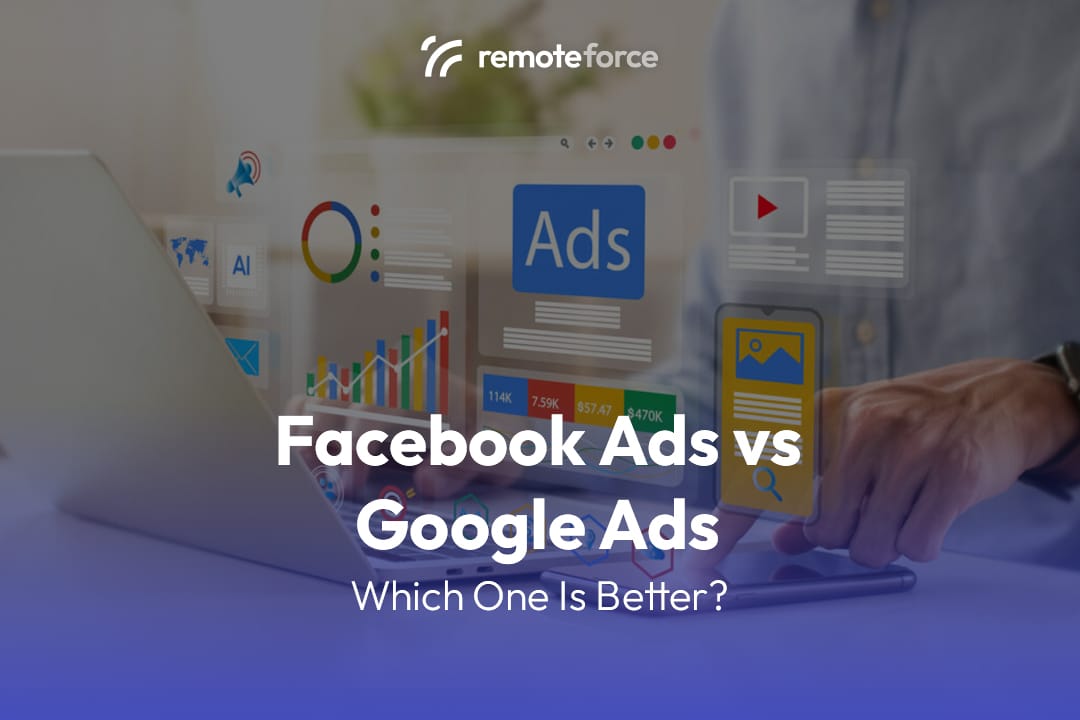
When it comes to digital advertising, the question isn’t whether you should be running ads, but where. The two titans of the advertising world, Facebook Ads and Google Ads, offer powerful ways to reach your audience, but they operate on fundamentally different principles.
Choosing the right platform is critical for maximizing your ad spend and achieving your business goals. This article will break down the core differences, strengths, and weaknesses of Facebook Ads and Google Ads to help you make an informed decision and build a winning digital marketing strategy.
Key Takeaways
The most successful digital marketing strategies leverage the strengths of both Google and Facebook Ads.
- Intent vs. Interest: Google Ads captures existing demand (people actively searching for a solution), while Facebook Ads creates new demand (pushing a product to a targeted audience based on interest).
- Google’s Strength: Best for quick conversions, high-intent products, and local businesses that solve immediate problems (e.g., emergency services, specific software).
- Facebook’s Strength: Unmatched for building brand awareness, promoting highly visual products (e.g., fashion, lifestyle), and reaching specific demographics/interests.
- The Strategy: Use Google as your “net” to capture ready-to-buy customers, and use Facebook as your “bait” to introduce your brand and products to an audience that needs to be nurtured.
- Budget Focus: Google Ads often has a higher Cost Per Click (CPC) but leads to higher-quality, immediate traffic. Facebook Ads often has a lower Cost Per Impression (CPM), making it better for building top-of-funnel awareness efficiently.
Facebook Ads vs Google Ads: Intent vs Interest
The most significant distinction between these platforms lies in how they connect with your audience.
- Google Ads is all about intent. Users actively search for something they need right now, whether it’s “plumbers near me” or “best CRM software.” Google’s platform, which includes Search, Shopping, and YouTube, allows you to place your ad directly in front of people who are already looking for a solution. It’s a pull-based marketing system you are pulling in an audience that is ready to act.
- Facebook Ads (which includes Instagram) is built around interest. Users are not actively searching for a product; they are Browse their social feed. Facebook’s sophisticated targeting allows you to push your message to a specific demographic based on their interests, behaviors, age, location, and connections. It’s a push-based marketing system you are pushing your product to an audience that might not know they need it yet.
This fundamental difference dictates when and how each platform is most effective.
Google Ads: The Power of Search and Intent
Google Ads is the go-to platform for capturing existing demand.
When to Use Google Ads
- High-Intent Products & Services: If your business solves an immediate problem (e.g., emergency plumbing, car repair, legal advice) or sells a product people actively search for (e.g., specific electronics, software, home goods), Google Search Ads are a perfect fit. You can appear at the top of search results the moment a potential customer is looking for you.
- Quick Conversions: Since you’re reaching an audience with a clear purchase intent, Google Ads often leads to faster conversions. People click on your ad because they are ready to buy or learn more about a specific topic.
- Local Businesses: For businesses that rely on local customers, Google’s local search ads and Google Maps integrations are invaluable for driving foot traffic and calls.
Pros of Google Ads
- High-Quality Traffic: The audience is actively searching, so the traffic is highly qualified.
- Measurable Results: It’s easy to track clicks, conversions, and ROI with precise data.
- Wide Reach: The Google Search Network reaches over 90% of internet users worldwide.
Cons of Google Ads
- High Competition: Highly competitive keywords can be expensive, driving up your cost-per-click (CPC).
- Limited Audience Discovery: It’s less effective for creating demand for a new product or service that people aren’t searching for yet.
Also Read: Facebook Marketing Tips for Small Businesses
Facebook Ads: The Power of Social and Discovery
Facebook Ads is a master at creating demand and building brand awareness.
When to Use Facebook Ads
- Building Brand Awareness: If your goal is to introduce a new product or service to a broad audience, Facebook’s extensive reach and visual-first platform are ideal. You can create captivating ads that build excitement and educate potential customers.
- Highly Visual Products: Fashion, home goods, art, and lifestyle brands thrive on Facebook and Instagram because of their visual nature. The platform is perfect for showcasing products through high-quality images and videos.
- Targeting Specific Demographics: Facebook’s detailed audience targeting is unmatched. You can reach people based on their life events, political views, hobbies, and even their favorite brands, allowing for incredibly precise campaigns.
Pros of Facebook Ads
- Excellent Audience Targeting: The ability to target by interest and behavior is a major advantage.
- Lower Cost: In many cases, the cost-per-impression (CPM) and CPC are lower than Google’s search ads, making it more budget-friendly for brand awareness campaigns.
- Versatile Ad Formats: You can use a wide range of creative formats, including images, videos, carousels, and stories, to tell a compelling brand story.
Cons of Facebook Ads
- Lower Purchase Intent: Users are in a social mindset, not a buying one. It often takes a more creative and convincing ad to convert them.
- “Ad Fatigue”: Audiences can become tired of seeing the same ads, requiring you to constantly refresh your creative content.
How to Strategically Allocate Your Advertising Budget
Once you decide to use both platforms, the next challenge is allocating your budget for maximum ROI. Your split should align with your business goals and the customer journey.
Budget Split Based on the Sales Funnel
A good starting point for a balanced strategy is to align the platforms with the sales funnel:
| Funnel Stage | Goal | Platform Focus | Budget Split Example |
| Top-of-Funnel (TOFU) | Awareness, Interest Generation | Facebook Ads (Visual content, broad interest targeting) | 60% |
| Bottom-of-Funnel (BOFU) | Immediate Conversions, Purchase | Google Ads (High-intent keywords, Shopping Ads) | 40% |
Cross-Platform Retargeting (The Synergy Budget)
This is where the two platforms deliver maximum value. You should dedicate a portion of your budget to connecting the dots:
- Facebook Retargeting: Use Facebook Ads to retarget users who clicked a high-intent Google Search Ad but didn’t convert on your website. Since the user is already aware of your brand, this creative, visual follow-up often converts well.
- Google Display Retargeting: Use Google’s Display Network to show banner ads to users who engaged with your brand on Facebook but haven’t visited your website recently.
Allocation Based on Product Maturity
- New/Innovative Product: Start with a heavier Facebook bias (70%+) to educate the market and create demand, as people won’t be searching for it yet.
- Established Product/Service: Use a Google bias (60%+) to ensure you capture every search query from ready-to-buy customers.
Also Read: Effective Online Marketing Strategies for Business
The Verdict: It’s Not a Battle, It’s a Strategy
The real answer to the “which is better” question is that neither one is inherently better, they are complementary. The most successful digital marketing strategies often involve a combination of both.
- Use Google Ads to capture existing demand from users who are ready to buy.
- Use Facebook Ads to generate new demand, build brand recognition, and target a highly specific audience that might not know about your product yet.
Think of it this way: Google is the net you cast to catch fish already swimming by, while Facebook is the bait you use to attract new fish to your fishing spot. By using both, you create a powerful, two-pronged approach that covers the entire customer journey.
Whether you’re trying to capture high-intent buyers or build a lasting brand, a coordinated strategy is the key to maximizing your budget and achieving sustainable growth. If you’re unsure where to start or how to manage both platforms effectively, our team of experts can help.
Ready to launch a digital marketing campaign that gets results? RemoteForce’s digital marketing services can help you navigate the complexities of both Google and Facebook Ads, ensuring your budget is spent wisely and your campaigns are optimized for maximum ROI.
Get in touch with us today on LinkedIn or Facebook!
Frequently Asked Questions (FAQ)
1. Which platform is generally better for B2B (Business-to-Business) companies?
Google Ads is often superior for B2B because professionals search for specific software, solutions, and consultancy services with high intent. However, Facebook/LinkedIn Ads are critical for B2B awareness and lead generation by targeting specific job titles, company sizes, and industry interests. A combined approach is ideal.
2. Is the cost-per-acquisition (CPA) lower on Facebook or Google?
There is no universal answer; it depends entirely on your industry and competition. Generally:
- Google CPA can be higher because you are bidding on high-intent keywords, but the lead quality is often higher, leading to faster conversions.
- Facebook CPA can be lower for lead generation, but these leads may require longer nurturing due to their lower initial purchase intent.
3. If I have a highly visual product (e.g., fashion, jewelry), should I ignore Google Ads?
No. While Facebook (Instagram) is crucial for awareness, you should still use Google Shopping Ads and Google Search Ads to capture users who search for terms like “black dress with sequins” or “local jewelry shops.” Google captures the final, purchase-ready search.
4. What is ‘Ad Fatigue’ and how do I prevent it on Facebook/Instagram?
Ad Fatigue occurs when your target audience sees the same ad creative too many times, leading to lower engagement, fewer clicks, and higher costs. You prevent it by:
- Constantly Refreshing Creative: Introduce new images and videos every 2-3 weeks.
- Excluding Recent Purchasers: Don’t show purchase ads to people who have already bought your product.
- Monitoring Frequency: Keep an eye on the “Frequency” metric; if it goes above 3 or 4, it’s time to change the creative.

- What Is Logo Design? A Complete Guide to Creating Memorable Brand Marks - February 2, 2026
- What Is Brand Identity? The Complete Guide to Building Recognition - February 2, 2026
- How Graphic Design Works: A Step-by-Step Process Guide - January 30, 2026